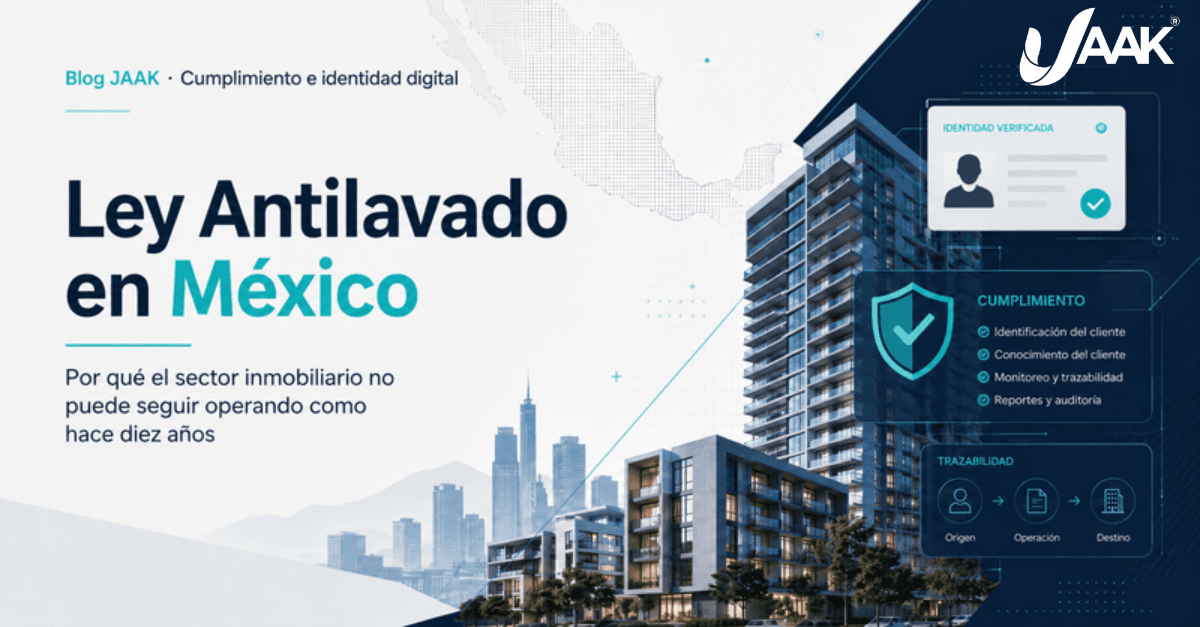
For years, the Mexican real estate industry operated under a simple premise: if you sell, notify and if you don't sell, nothing happens. That premise no longer exists. On July 16, 2025, the Federation's Official Journal published a Decree amending the Federal Act for the Prevention and Identification of Transactions with Inetidal Promises (LFPIORPI) - the so-called Anti-Willing Act - and since then the real estate sector has been out of place to operate with crafts processes with an authority that today requires traceability almost in real time.
From JAAK We have been accompanying tens of organisations - developers, real estate, middlemen and civil servants - in the transition to digital compliance. What we have been monitoring in recent months isn't just a normative change: it's a change of expectations. The authority doesn't ask if you have identified your client, and it's assumed that you should have already been, and it's asking you to prove it.
The reform that closed a decade's void
Before July 2025, section V of Article 17 of the LFPIORPI grouped three very different activities under a single assumption: building, brokering and selling. This created a huge gray area for pre-sale developments: if a project did not yet have a final buyer, was it already a vulnerable activity or not?
The reform solved this ambiguity by creating an independent fraction - V. Bis- that defines the development of real estate as a project for construction or fractioning of lots intended for sale or rent and that makes the receipt of resources for that purpose vulnerable, without waiting for a formal sale.
A vital point
The most important and least discussed change in the sector is that the new fraction no longer requires that activity be regular or professional: a single operation is sufficient to generate obligations, even if this isn't the main turn of the recipient. That expands the universe of forced subjects far beyond the great developers, to trust, project partners and even individuals that contribute capital to an individual development.
A new Regulation was published in March 2026. LFPIORPI That added very concrete operational obligations for those who were already within the best name:
- Annual audit with an independent third party's opinion at high risk.
- Formal identification of politically exposed persons (PEP).
- Clear rules for aggregating transactions over six-month periods.
- Warning of 24 hours if there's an attempt at a suspicious operation, even if it's never concrete.
Why the real estate sector's at the centre of the radar
It's no coincidence that this reform has just been initiated here. The FATF (FATF) - the body that evaluates Mexico with respect to money laundering prevention - has repeatedly referred to the real estate sector as one of the most poorly monitored channels in the country and the 2025 reform itself is partly explained as a response to bridging gaps before the FATF's fifth mutual assessment to Mexico.
The numbers confirm this. According to published figures about reports received by the Financial Intelligence Unit (UIF), the real estate sector generated more than 286 thousand notices within a period of just five months. It's, with the financial sector, one of the largest information generators for financial intelligence in the country.
+286,000
Retirement and Retirement UIF in 5 months
+70,000
Retirement and rights information
+141,000
Notice of personal rights of use or enjoyment (rent and lease)
For agent, developer or office that operates every day, this translates into a very concrete question: would my current client identification process resist an audit of the UIF or SAT today, without notice?
What we have been watching from JAAK: the actual demand of the sector
In our daily discussions with the industry, we found a pattern that's repeated with almost no exception, regardless of the size of the organisation:
Compliance exists but lives scattered
copies of INE scanned in Drive folders, contracts signed on paper and digitalised later, handheld warnings a day before the deadline. It's no lack of will: it's that the earlier frame did not require - and did not offer tools to - a centralized management of the file.
That's true.
Most of the agents and developers we talked to did not know, before we explain them to them, that there's no more minimum amount to start client identification, or that the V Bis fraction can now apply them even if their main activity isn't real estate development. The law changed faster than information reached the sector.
The risk isn't just a fine.
with up to 65,000 UMA or 100% of the value of the event and with an obligation to keep the file ten years under audit, the true risk is reputiational: to be noted in an investigation of the UIF for an onboarding process that should never have been so permissive.
What we think the sector's doing right
With all this, we also see - and say with the same honesty with which we point out challenges - a genuine movement of organisations that are leading up. Developers who have already been a full-time enforcement officer before they have been formally required by law. Inmobiliaries who have been digitalizing their identification file as a procedure, but as an asset of confidence to investors and buyers. Legal despachos that are translating reform into internal policy manuals that are understandable for commercial equipment, not only for lawyers.
That's exactly the type of transformation that the sector needs: we do not see compliance as an isolated administrative burden but as part of the same confidence infrastructure with which a property is already sold, a contract signed or an investment caught. The organisations that are first understanding this are, today, the least frictionalities will have when the general rules outstanding from the new Regulation have been published.
How to participate JAAK at this transformation
Our role isn't to replace the compliance officer and the legal advisor of a developer - that responsibility and the criterion that requires them to be human. Our role is to remove to compliance the part that today is made by hand and that best exposes to mistakes: client identification, monitoring his or her identity, crossing against risk lists and politically exposed persons, and keeping the file with legal validity throughout time.
Expand dispersed into folders and paper
Centralised digital record, generated at each onboarding with document, biometrics and change history.
Manual and clear-light identification
Biometric monitoring of identity and OCR about INE or a passport with no human intervention at validation.
Manual crossing with public lists
Automatic treatment of risk lists and politically exposed persons at every operation.
File without an integrity guarantee
Maintenance of the file with a stamp of time and legal validity under the NOM-151ready for audit.
In practice, that means that a process that today takes weeks - to demand an identification copy, to check them at a glance, to cross manually against public lists, to file into a physical or digital folder with no guarantee of integrity - becomes a minutes flow with biometric monitoring, automatic matching with risk lists and a file with a stamp of time and legal validity under the NOM-151. Not for an organization to depend on a platform but to have solid evidence the day that authority requests.
The conversation just starts
We believe that the conversation about the Anti-Willing Act in the real estate sector soon begins and that in the coming months - as the outstanding general rules are published - we will see a second wave of adjustments. Our intention is to accompany that conversation with verifiable information, and with tools that solve the real problem: turning a legal obligation into a digital, auditable and defensible file.
Official and specialized sources consulted
- Official Journal of the Federation - Decree amending LFPIORPI16 July 2025
- SAT - Money Laundering Prevention Portal (SPPLD)
- SHCP - National Assessment of Money Laundering and Terrorist Finance Risks
- Corporate IDC - LFPIORPI: new obligations following published reform
- EY Mexico - Reform of the Anti-Lavage Act 2025: impact and new obligations
- Inmobiliare - Unwashed information about the real estate sector: UIF gets more than 286 million reports in five months
Note: some figures (such as the UMA value and the amount equivalent to the notice threshold of 8,025 UMA) are updated annually. This article uses the value in effect in 2026; verify the daily UMA value published by INEGI before citing it in materials dated later.