Each year, billions of pesos are passing through fraudulent financial accounts and structures in Mexico. The consequences go beyond economic losses: they fund illicit activities, erode confidence in the financial system and put businesses and managers at risk of criminal liability. KYC - Know Your Customer - it's the first barrier that every organization can put up. Nevertheless, many companies are still unclear about what it really means, who are legally required to implement and how to do so without generating friction with their customers.
What's that? KYC- Know Your Customer
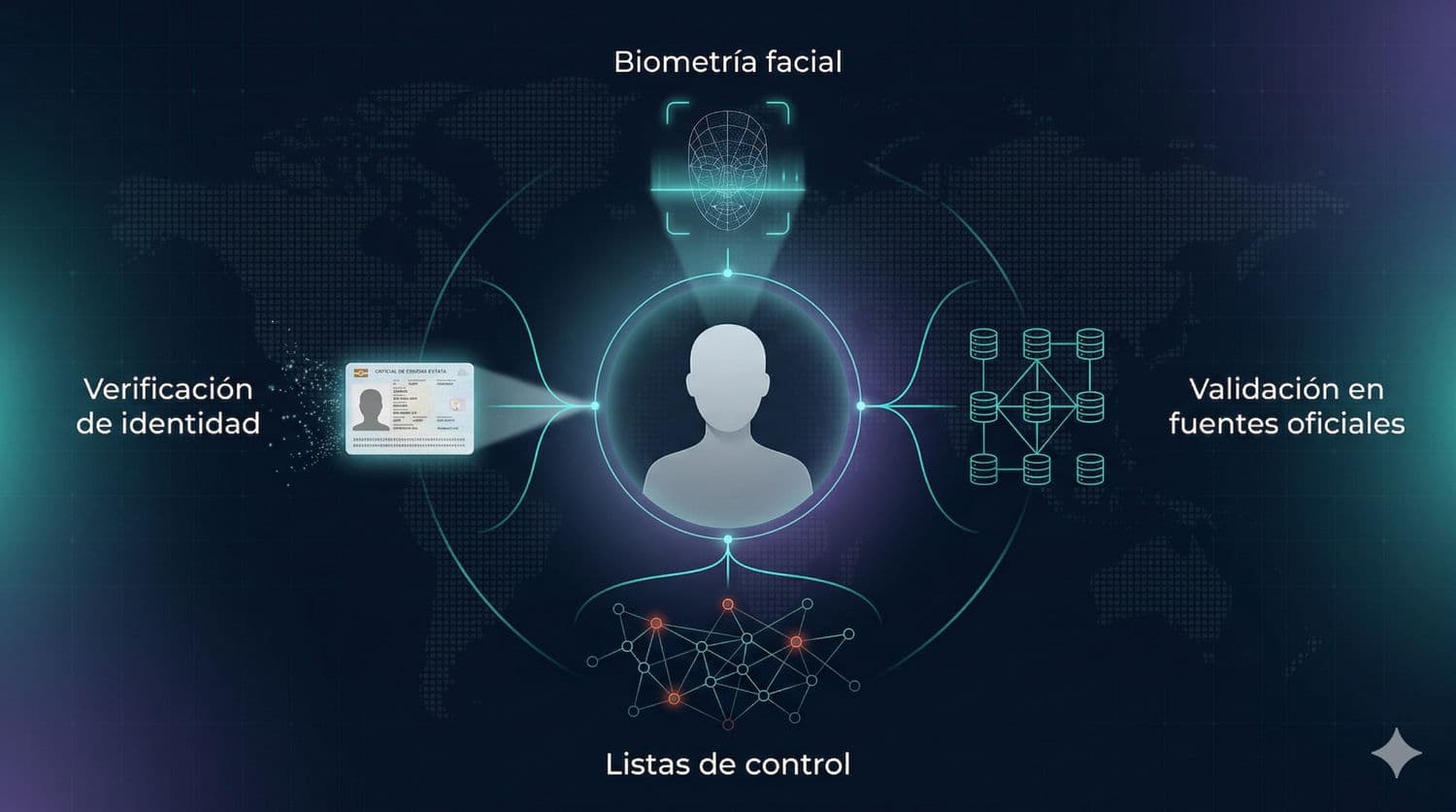
KYCand Know Your Custom (Know your Customer), is the set of processes by which a company verifies its customers' identities before establishing a commercial or service relationship. It's not simply a bureaucratic procedure: it's a structured process that includes the monitoring of identity documents, validation of data from official government sources, consultation of monitoring lists of sanctioned or politically exposed persons and evaluating the client's risk profile.
Unlike a superficial validation of name and email, KYC aims to ensure that the person or undertaking with whom they are operated is exactly who they say they are, that they do not appear on international or national sanctions lists and that their risk profile is consistent with their intended operation.
Key concept:
KYC is not an administrative formality. It is the first barrier against money laundering, terrorist financing and identity fraud.
The legal framework in Mexico
Mexico's obligation to implement processes KYC It appears from three main policy pillars that every company with money-laundering prevention obligation should know:
1. LFPIORPI - Federal Act for the prevention and identification of operations with illicit conduct
Colloquially known as "Anti-Lavado Law," LFPIORPI regulates so-called Vulnerable Activities - economic sectors with high risk of being used for money laundering. The law requires those performing these activities to fully identify their customers before they start any operation, to keep auditory records of these identifications and to refrain from receiving cash payments that exceed established thresholds.SAT) through the Evaluation and Control Unit.
2. Provisions of CNBV - National Banking and Securities Commission
For regulated financial system entities - banks, Sofomes, Sopipes, credit unions, stock exchange houses, among others -, CNBV lays down general provisions concerning PLD (Money-laundering prevention) and FT (Terrorist financing). These provisions set out detailed customer identification requirements with their risk profile with differentiated obligations for low, medium and high risk customers, including the periodicity with which the required files and minimum documents have to be updated.
3. UIF - Financial Intelligence Unit
The UIFand public credit (SHCP), as the recipient of reports of unusual and relevant operations generated by both regulated financial institutions and those required by LFPIORPILa. UIF lays down criteria and formats for these reports, manages lists of blocked persons and coordinates with international agencies such as FATF (FATF) the update of sanctions lists.
Who are forced to do KYC?
The obligation to implement processes KYC Mexico has two main categories of subjects:
A. Financial institutions regulated by CNBV
They have the most strict and detailed obligation to implement KYCwith direct and continuous supervision of the authority:
- Credit institutions (commercial and development banks)
- Multipurpose Financial Companies (FFY)
- People's financial corporations and savings banks
- Credit unification
- Insurance and maintenance companies
- Exchange houses and investment fund operators
- Money exchange and transmission centres
- Financial Technology Institutions (regulated Fintings)
B. Subjects bound by Vulnerable Activities (LFPIORPI)
Those sectors are not regulated by CNBVbut for LFPIORPI and have concrete obligations to identify their clients as they exceed the thresholds established by law:
- Retirement and development agents (operations above the established threshold)
- New and used vehicles distributors (cash sales)
- Public accountants, notaries and public dators
- Casinos, playrooms and lotteries
- Beetmakers, precious metal and works of art
- Security and shielding service providers
- Loan and factoring companies
- Service or prepaid card traders
What includes a process KYC complete?
A process KYC robust and complying with Mexican regulations should cover four essential components:
1. Documentary identity checks
Automatic capture and analysis of an official identity document (INE/ FIT or passport for persons with a status report and notary powers for moral persons). OCR data from the document are extracted and validated by monitoring the consistency of information and by detecting potential changes or falsifications.
2. Life-proof biometric monitoring
Facial recognition with liveness detection confirms that the person registering is who they claim to be and is present in real time. This technology detects impersonation attempts using photographs, pre-recorded videos or three-dimensional masks, known as presentation attacks or deepfakes, ensuring that the process cannot be bypassed remotely.
3. Validation from official government sources
The data caught are contrasted in real time against the authorities' databases: CURP valid before the National Population Registry (Renapo), the elected credit is verified against the sign of the National Electoral Institute (INE) and RFC valid to the Tax Administration Service (SAT). That cross-validation is vital for the detection of cloned documents or data that do not belong to an official registry.
4. Consultation with monitoring lists
Once an identity has been verified, the client's profile is consulted on national and international monitoring lists: the list of people blocked from UIFSection 69-B of the Federation's fiscal code (blacklist) SAT), the lists of the Office of Foreign Assets Control (OFAC) from the U.S. Treasury and the consolidated UN sanctions lists. PLD/AML.
What if you don't implement KYC?
Non-compliance with obligations KYC That's not a theoretical risk: Mexican authorities have significantly increased their monitoring and punitive activity in recent years. The consequences for businesses and their managers can be serious and in many cases irreversible:
- Economic and Social CNBV or SAT: Fines can reach very significant figures depending on the gravity of the infringement and the size of the sanctioned entity.
- Cancellation of authorisation to operate: In cases of repeated or particularly serious non-compliance, an authority may revoke an entity's licence or authorisation to conduct operations.
- Criminal liability: The officials and officials responsible for compliance can face criminal charges in cases where non-compliance actively facilitates money-laundering or terrorist financing operations.
- Reputational irreversible damage: A public sanction CNBV or UIF can destroy an institution's reputation in the financial market, affecting relations with bank correspondents and institutional customers.
- Become a money-laundering vehicle: Without proper processes KYCthe company can be used - consciously or otherwise - to wash up remedies of illicit origin, and this greatly increases its legal exposure.
Regulation warning:
Fines for non-compliance with LFPIORPI They can reach up to 65,000 times the minimum daily wage. CNBVThe penalties may be even greater depending on the gravity and recurrence of the infringement.
KYC and customer experience: are they supported?
There is a myth rooted in many commercial and product equipment: that KYC That demand document, conduct checks and apply controls inevitably generates abandonment in the onboarding process. That belief was valid a decade ago, when processes KYC They required physical presence, paper forms and manual revisions that could take days or weeks.
The reality in 2026 is completely different. With today's technology, a complete KYC process (document verification, biometric liveness detection and validation against government sources) can be completed in under three minutes from a smartphone, with no paper, no physical trips and no human intervention. The key is to automate verification without sacrificing the user experience.
Institutions that have adopted KYC modern digital report conversion rates above 85% in onboarding processes, compared with 40-60% with those with manual or hybrids. KYC itself: it comes from maldesigned processes that implement it.
FAQ about KYC in Mexico
The KYC That's just for banks?
No. Although banks have the most strict and detailed obligations, the obligation to implement KYC applying also to Sofomes, SoFipes, credit unions, stockhouses and, through LFPIORPIand to all subjects performing Vulnerable Activities as real estate agents, car distributors, notaries, casinos and precious metal traders, among others.
How often do we have to renew the KYC from a client?
It depends on the risk profile assigned to the client. In general, CNBV provisions establish that clients classified as high risk must have their file updated at least once a year; those at medium risk, every two years; and those at low risk, every three to five years. Institutions may set stricter criteria based on their internal risk management policy.
What documents are required for KYC?
For individuals, the minimum documents are the voter ID (INE/IFE) or a valid passport, and the Clave Única de Registro de Población (CURP). Depending on the risk level, a recent proof of address may also be required. For legal entities, the articles of incorporation and their amendments, the tax identification certificate (RFC), proof of tax address, and the official identification of the legal representative with the corresponding notarial powers are required.
The KYC have the same legal validity as the face?
Yes, as long as it includes appropriate verification mechanisms and generates an auditable record. CNBV provisions expressly recognize non-face-to-face onboarding processes, including facial biometric verification with liveness detection and validation against government sources. What matters most is that the process generates sufficient evidence that can be presented to an authority in the event of an audit or investigation.
How to implement KYC at your company
The implementation of a process KYC efficient doesn't have to be a long and expensive project. JAAKthere are three implementation routes depending on the technological needs and maturity of each organisation:
Self-service - Start today without technical integration
Access the platform JAAK from the browser and starts to check identities immediately. Ideal for equipment that require an operational solution while preparing a deeper integration, or for cases of mean volume use that do not warrant an implementation of API dedicated.
Integration via API — KYC embedded in your platform
Connects JAAK directly into your onboarding application or system using API REST. with complete documentation and dedicated technical support, integration can be ready in days. Ideal for digital platforms, mobile apps and credit origination systems.
Consulting - Custom design of your compliance flow
The equipment JAAK work directly with your compliance area, legal and technology to design the flow KYC specific that you require according to your applicable regulations, client profile and risk tolerance. It includes policy review, definition of risk criteria and accompaniment to the audit validation process.
The KYC That you need
The best KYC is the one that meets regulation without adding friction for the customer. With modern technology, you no longer have to choose between the two.
In a constantly tightening regulatory environment and a market where identity fraud grows year by year, implement a KYC Robust isn't an option: it's a condition to operate with legal and reputiational security. The good news is that today's technologies can meet all regulatory requirements and at the same time offer an agile and completely digital registration experience to customers.