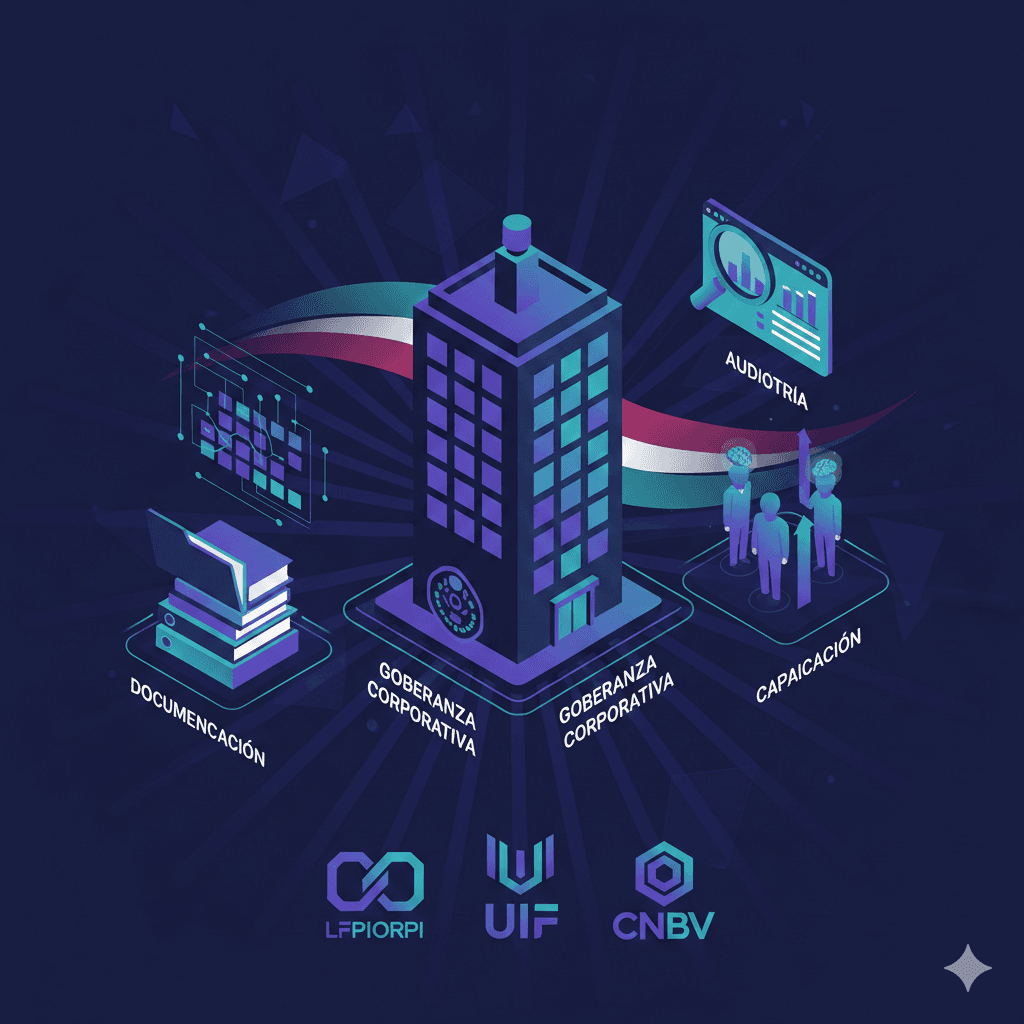
Regulation enforcement in Mexico is not only a legal obligation but a competitive advantage. Companies with solid compliance programs generate more confidence in customers, investors and authorities. That guide offers a useful framework for building and maintaining an effective compliance program.
The Mexican regulatory ecosystem
The regulated companies in Mexico have to comply with many interlinked regulations. Understanding this ecosystem is the first step to an effective compliance.
LFPIORPI
Federal Act for the Prevention and Identification of Transactions with Illawful Promises
- • Define vulnerable activities
- • Established reporting thresholds
- • Customer identification obligations
Provisions UIF
FIU - SHCP
- • Unusual operations reports
- • Relevant operations reports
- • Maintenance of documentation
Provisions CNBV
National Banking and Securities Commission
- • Customer identification requirements
- • Customer knowledge policies (KYC)
- • Monitoring operations
LFPDPPP
Federal Act on Protection of Personal Data
- • Treatment of personal data
- • ARCO rights
- • Privacy notices
The pillars of a compliance program
An effective compliance programme is built on five core pillars:
1Governance and culture of compliance
Compliance should be a priority from high management to every employee.
- • Designated compliance officer with authority and resources
- • Compliance Committee with high leadership participation
- • Written and accessible policies for all personnel
- • Tone from above: leadership that models ethical behaviour
2Risk assessment and management
To identify, measure and mitigate the specific risks of your organisation.
- • regularly updated risk matrix
- • Customer classification by level of risk
- • Due care for high-risk customers
- • Monitoring of risk profile changes
3Policies and procedures
To document clear processes to ensure consistency and audibility.
- • Manual PLD/ FT updated
- • Customer identification procedures (KYC)
- • Stretching protocols for suspected cases
- • document maintenance policies
4Ongoing training
The trained personnel are the first line of defence.
- • Initial training programme for new employees
- • Regular updates on regulatory changes
- • Specific training by role and level of exposure
- • Assessments to verify understanding
5Monitoring and audit
To constantly check that controls work as expected.
- • Monitoring of real-time transactions
- • Regular internal audits
- • Control performance tests
- • independent checks by third parties
Customer knowledge (KYC)
The KYC That's the basis of any compliance program.
and KYC robust:
- Identification: Obtain information and document that attests to an identity
- Verification: Confirm that information is true and valid
- Knowledge: To understand the purpose of the expected relationship and activity
- Monitoring: Monitoring activity to detect inconsistencies
- Updating: Maintain information throughout the relationship
Due care by level of risk
Not all customers require the same level of scrutiny. Implement a risk-based approach:
| Level of risk | Characteristics | Due diligence |
|---|---|---|
| Low | Standard customers, typical operations | Simplified: basic data, standard monitoring |
| Medium | Commercial activity, moderate amounts | Standard: complete monitoring, regular monitoring |
| Stop | PEPs, risk jurisdictions, sensitive activities | Reinforced: high management approval, intensive monitoring |
Political Exposed Persons (PEPs)
PEPs require special attention as a result of their increased exposure to the risk of corruption:
- Proactive identification: Consult specialized databases at first and regular intervals
- Family and partners: Expand scrutiny to people close to PEP
- Special approval: Requires high management authorisation to set up a relationship
- Origin of funds: Documenting where the resources come from
- Strengthened monitoring: Most common review of transactional activity
Report to UIF
Realizing to report obligations is crucial:
Reports of Relevant Operations
operations that exceed the thresholds established by LFPIORPI.
- • Deadline: 17 working days of the following month
- • Formatting: Through the portal of UIF
- • Content: Customer and operation data
Innusual operations reports
Operations with atypical or suspicious characteristics.
- • Target date: 24 hours of detection
- • Analysis: documenting the reasons for suspicion
- • Confidentiality: Do not alert the client
Maintenance of documents
The documentation is your defence to authorities and audits:
- Minimum time: 10 years after end of trade
- Format: Original or digitalised copies with legible quality
- Accessibility: Available for authorities up to 72 hours
- Integrity: Mechanisms to ensure that they have been unchanged
- Organization: System enabling efficient search and recovery
Documents to be retained
Penalty for non-compliance
The consequences of noncompliance can be severe:
Possible sanctions:
- • Fines: Up to 65,000 MMUs for infringement (~ $7.6 million) MXN)
- • Suspension: Activities or operations
- • Revocation: Loan for operation
- • Criminal liability: For officials in cases of malfunctioning
- • Reputational damage: Loss of confidence by customers and investors
Technology as an ally of compliance
Modern technologies make them more efficient to achieve:
Automated identity check
Valids document, biometrics and data in seconds with perfect consistency.
Monitoring of transactions
It detects unusual patterns automatically and generates real-time alerts.
Screening of lists
Automatic consultation of national and international PEPs, sanctions and blacklists.
Reporting generation
Automates the creation of regulatory reports in required formats.
Compliance checklist
Use this list to evaluate your program status:
Conclusion
An effective compliance program isn't an expense, it's an investment that protects your business, strengthens your customers' confidence and puts you favourably with regulators. In an increasingly monitored environment, companies with a strong compliance culture will be the ones that thrive.