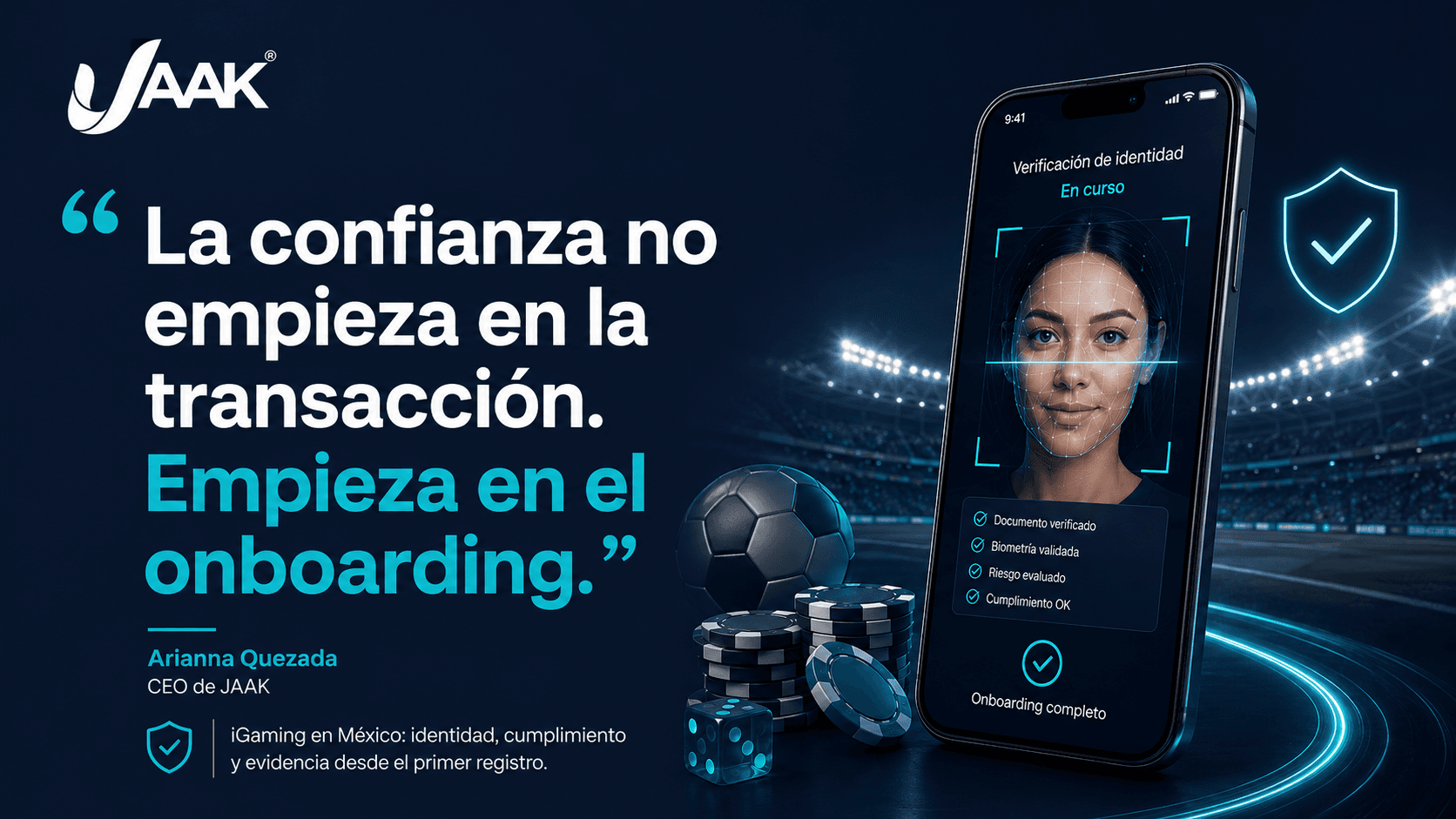
A few days ago I participated in Stablecoin Conference LATAM 2026, a space where we talked about a lot of payments, financial infrastructure, new models of operation and technology. But beyond the specific theme of the event, there was a conversation that I found increasingly important to any digital industry that moves money: confidence.
When an operation grows, as users multiply and as transactions occur in seconds, the question isn't just how to scale.
The question is how to climb without losing control.
That conversation directly links with one of the sectors we are currently working with special attention to JAAK: iGaming. In Mexico, play and betting operators face a very particular challenge. It's not enough to have good registration experience. It's not enough to demand an identification. It's not enough to reduce friction.
In this article you will find:
An analysis about why iGaming's onboarding is the first risk filter, what Mexican regulation requires, how to scale with traffic peaks and why evidence is part of the infrastructure - not a later procedure.
The true challenge lies in connecting what the law requires with an infrastructure capable of demonstrating compliance at every stage of the onboarding.
Because at iGaming, identity isn't an operative step.
That's the starting point for compliance.
The law isn't enforced with intention and it's enforced with infrastructure.
In any digital industry confidence is often referred to as a value but in regulated sectors confidence should also exist as evidence.
That's especially important at iGaming, where every user's high can become an operational, transactional and regulatory ratio. A player isn't just a database registry. It's an identity that can place, withdraw, accept terms, participate in promotions, move resources, generate alerts and be part of processes that have been reviewed.
That's why onboarding should not be seen only as a conversion stage.
- The onboarding's the first risk filter.
- That's the first point of control.
- It's about time a platform decides if you really know the person you're letting into your operation.
And in Mexico, that decision should not be made with improvised processes, scattered evidence or validation that cannot be sustained after that.
The problem is not verifying. It is being able to prove that you verified.
Many companies believe that compliance means applying for an identification but applying for an identification isn't the same as checking an identity and checking an identity isn't the same as showing how that process happened months later.
For an iGaming operator, the critical question isn't just: "Did the user pass the KYC?"
The really important question is:
"Can we prove who she was, what we validated, when she happened, what evidence we held and under what process she was approved?"
That difference is central, because when there's an audit, an alert, an internal review or an information request, compliance isn't intended to be explained.
A mature operation should be able to answer questions such as:
- Who opened this account?
- What document did you propose?
- He's been valid for his age?
- Did it have been found that his face was consistent with his submitted identity?
- Have risk lists been consulted?
- A file was generated?
- The evidence was preserved?
- The consent was supported?
- The flow was consistent for thousands of users or only for some cases?
If these responses live with different systems, different providers or archives that are difficult to rebuild, the operation can work commercially but be regularly weakened.
The growth of iGaming requires high volume controls
At iGaming, growth doesn't always occur gradual. It can come from procurement campaigns, supplier changes, sports events, promotions, high traffic seasons or from market growth itself. When that happens, onboarding becomes an infrastructure test.
If the flow's slow
users leave.
If the flow's weak
The fraud goes in.
If it doesn't generate evidence
compliance remains incomplete.
That's why platforms that seek to grow up in Mexico should not only ask how quickly users can register. They should also ask:
- Can we check thousands of identities without losing control?
- Can we prevent multiple bills and bonus abuse without punishing the legitimate user?
- Can we detect risk signs before they get to retirement?
- Can we have evidence of every decision?
- Can we respond to compliance, audit or authority without manually rebuilding processes?
At high-volume operations, the risk does not appear only when someone tries to disappoint them. It also appears when the company cannot explain how it made its decisions.
What Mexican Regulation Requires us To Watch
Mexico has a particular regulatory framework for play and drawing. There are clear obligations, interpretation zones and operational expectations that aren't always translated into specific technological procedures. That doesn't mean that operators can operate without controls. That means they have to build controls sufficiently robust to fulfill, adapt and prove.
From an onboarding perspective, there are three great issues that iGaming leaders should have been clear about.
1. Identification of player
The Regulations of the Federal Act of Games and Sortings lays down that internal monitoring systems have to register at least the account and identity number of the gambler, including at bets that have been caught through the Internet, phone or electronic. The operation should be able to associate an account with an identifiable person. It's not enough with an email or phone number.
2. Preventing operations with illicit remedies
The LFPIORPI considers activities related to gambling, contest or drawing as vulnerable activities. That requires them to design controls to identify customers, detect risk signs, preserve information and respond to obligations PLD.The iGaming doesn't only process entertainment: it also moves resources.
3. Conservation and traceability
Compliance does not end with registration's approval. In many cases, true value is capable of recovering evidence as necessary: who was verified, what information was obtained, what validations occurred and what consent was supported. LFPIORPI lays down information retention requirements and the possibility of monitoring visits with non-compliance sanctions.
In JAAKwe see these three points as part of a same conversation: Identity, Risk and Evidence. Separation them can generate operational friction. To integrate them can become a strategic advantage.
For CEOs, CTOS, CISOS and enforcement officers, the challenge is the same
Each role looks at it from a different angle but the problem is shared.
CEO
Scaling operation without increasing regulatory exposure.
CTO
To integrate reliable, available and high-volume infrastructure.
CISO
To protect sensitive information, reduce abuse vectors and maintain control about critical processes.
Compliance Officer
Prove that the company knows its users, monitors risks and preserves evidence.
The mistake would be to think that these are separate conversations. Actually, they are all found at the onboarding. Because that's where the relationship with the user is born. That's where we get an identity. That's where we evaluate the risk. That's where we get consent. That's where we get evidence.
And if that entry point isn't well designed, anything that happens after that becomes more difficult to defend.
Not everything. KYC It's the same for Mexico
One of the most important discussions we have at JAAK That's how to translate Mexican regulations into concrete operations flows.KYC"as a generic functionality. It's about understanding what a company that operates in Mexico needs to build an enabling infrastructure.
That means considering:
- Identity ratings aligned with local context
- Facial biology with Mexican sources
- Consultation of relevant risk lists
- Digital file generated from first step
- Digital signature and supported consent
- Conservation of information integrated with flow
- Processes that can be interacted with compliance and operation areas
At iGaming, this difference matters a lot. A platform can have a quick record but not necessarily a justifiable record. It can have documentary validation but not necessary complete evidence. For high-volume operations, that fragmentation becomes a weakness.
Fraud also goes up
When a platform grows up, it doesn't just attract more legitimate players. It also attracts more fraud attempts. At iGaming, vectors can be different: multiaccounts, bonus abuse, synthetic identity, third party use, money mules, control evasion attempts or suspicious patterns associated with deposits and withdrawals.
That's why, KYC cannot be limited to a photo document. A robust flow should help answer:
- Is this person real?
- The document corresponds to his face?
- Do their identities have risk signs?
- Are there matching with relevant lists?
- Is subsequent behavior consistent with profile?
- The evidence became available for review?
The goal should not be simply to reduce friction. The goal should be to reduce friction without losing compliance.
The World Cup and traffic peaks aren't just a commercial opportunity
The sporting context of the coming years will put pressure on many iGaming platforms. More users, more campaigns, more searches, more deposits, more retreats, more promotions, more abuse attempts.
For commercial area, this represents growth. For compliance area, it represents exposure. To technology, it represents capacity. To security, it represents attack area.
That's why preparing for high volume doesn't mean just supporting traffic. It means supporting decisions:
- Identification decisions
- Risk decisions
- Decisions to approve and block
- Conservation decisions
- Reporting decisions
In a mature operation, each of these decisions should be clear.
Evidence's part of the experience, not a later procedure.
Many companies treat evidence as something built after: first they register users, after they try to order documents, after they integrate lists and after they seek to back up conjunctions. That order generates operational debt.
Instead, when onboarding is born as compliance infrastructure, evidence is generated from the start. Each validation, every acceptance, every consultation and every decision can be part of a file. That allows the operation to be free from manual reconstructions.
The evidence should not be a later procedure. It should be a natural part of the experience and also allows commercial, technological and compliance areas to work on an equal basis.
What we're building from JAAK
In JAAK we are working on a clear vision: to help companies turn their demand for identity and compliance into operational infrastructure.
For iGaming, that means accompanying onboarding with technology that can verify actual identities, reduce fraud risks, consult relevant lists, generate evidence, integrate digital signature and preserve files that can support the operation.
We don't see the KYC as an isolated step. We see it as a layer of confidence that connects product, technology, compliance, security and business.
Because sustainable growth doesn't depend only on acquiring users. It depends on knowing who they are, how they entered and what evidence supports that relationship.
Trust as an infrastructure
Following discussions about financial infrastructure, payments and new technologies, I have an even more clear conviction: innovation can accelerate many things but confidence remains the most important infrastructure.
And at iGaming, that confidence starts before the first deposit. It starts with the onboarding. It starts with a platform that decides to leave its identity at the end of the process but puts it at the centre of its operation. It starts with compliance as an obstacle but an architecture.
It starts as soon as the company can say "we check," but "we can prove it."
For leaders that are building the future of iGaming in Mexico, the question should no longer be if they need KYCThe question is what kind of infrastructure they need to scale with control. Because in a digital operation, each registry counts. But every verified identity counts even more.
Regulation reference sources
- Regulations of the Federal Games and Sortings Act - Chamber of Deputies
Internal control, bookkeeper's name and electronic betting channels.
- The Federal Act for the Prevention and Identification of Transactions with Inetidal Promises (LFPIORPI) - Chamber of Deputies
Vulnerable activities, identification obligations, information retention and sanctions applicable to play and drawing.
Do your iGaming operation need to climb their onboarding without losing control?
Know how JAAK helps check identities, prevent fraud and generate evidence for compliance in Mexico.
Agenda a demo